911 Carrera 4 S Cabriolet
355 hp @ 6,600 rpm
0-60 mph: 4.7 sec.
Top Track Speed: 179 mph
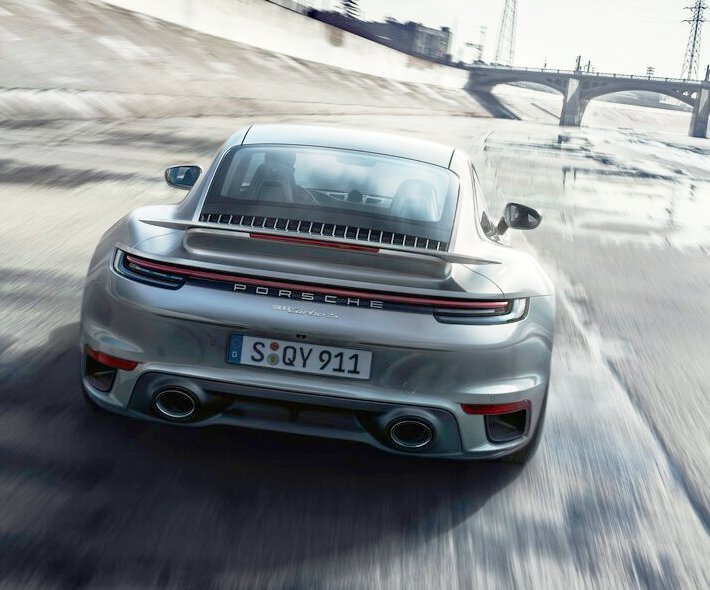
911 Turbo
480 hp @ 6,000 rpm
0-60 mph: 3.7 sec.
Top Track Speed: 193 mph
911 Turbo Cabriolet
480 hp @ 6.000 rpm
0-60 mph: 3.8 sec.
Top Track Speed: 193 mph
911 GT2
530 hp @ 6,500 rpm
0-60 mph: 3.6 sec.
Top Track Speed: 204 mph
911 GT3
415 hp @ 7,600 rpm
0-60 mph: 4.1 sec.
Top Track Speed: 193 mph
911 GT3 RS
415 hp @ 7,600 rpm
0-60 mph: 4.0 secs
Top speed: 193 mph

Factory TurboCharged Porsche's  - Everyday Supercar?

 
PORSCHE Turbo's  924   944   964   930   911   996   997   


The 944 Turbo, had a turbocharged and intercooled version of the standard car's engine that produced 220 hp (217 in the US) at 6000 rpm. The turbo was the world's first car using a ceramic portliner to lower exhaust gas temperatures. The Turbo also featured several other revisions, such as improved aerodynamics, a strengthened gearbox, optional transmission oil cooler, wider wheels, and uprated suspension. Major engine component revisions, more than thirty in all, were made to the 951 to compensate for increased internal loads and heat.

Porsche introduced the 944 Turbo S in 1988 . The 944 Turbo S had a more powerful engine with a designated number of M44/52 that achieved 247 hp compared to the standard 944 Turbo's 217 hp. Torque was increased to 250 ft·lbf (339 N·m) versus 243 ft·lbf. The higher output was obtained by using a larger AR turbo housing on the exhaust side, and a remapped ECU. The 944 Turbo S was said to do a 0-60 mph time of 5.5 seconds and a quarter mile time of 13.9 seconds at 101 mph (163 km/h).


The 944 Turbo S suspension was upgraded Koni adjustable shocks front and rear, and ride height adjustment threaded collars on the front struts, progressive springs, larger rear torsion bars, harder bushings throughout, larger 26.8mm sway bars in the front, and chassis stiffening brackets in the front frame rails. The 944 Turbo S wheels, known as the Club Sport design, were 16" forged and flat-dished, Wheel widths were 7.5 inches (191 mm) in the front, and 9 inches (229 mm) in the rear; sizes of the Z-rated tires were 225/50 in the front and 245/45 in the rear. The front and rear fender edges were rolled to accommodate the larger wheels. The transmission of the 944 Turbo S had hardened first and second gears including synchros, standard external cooler (available on earlier turbos as an option), and a standard limited slip differential with a 40% lockup. The Turbo S front brakes were borrowed from the Porsche 928 S4, with larger 4 piston, fixed calipers and rotors; ABS was also standard.

The 944 Turbo S interior featured full power seats for both driver and passenger in "Burgundy plaid" as well as a 10 speaker sound system and equalizer + amp as standard features.

In 1989 the 'S' designation was dropped from the 944 Turbo S, and all 944 Turbos featured the 'S' package as standard.


Porsche Releases Details On the 2008 911 Turbo Cabriolet

All-new open-top flagship boasts supercar performance, and every day driving qualities

ATLANTA – MAY 7, 2007 – Stuttgart, Germany based Porsche AG today shared initial details about the new 911 Turbo Cabriolet. When it goes on sale in September 2007 in North America, the 2008 911 Turbo Cabriolet will take its rightful place at the top of Porsche’s sports car hierarchy and will continue Porsche’s 20-year tradition of offering an open-top turbocharged 911 sports car for those who yearn for the ultimate open-air Porsche driving experience either on the track or on the boulevard.

The 911 Turbo Cabriolet features the same 3.6-liter, six-cylinder, twin-turbocharged boxer engine found in the 911 Turbo Coupe. Using Variable Turbine Geometry (VTG), the powerplant generates 480 horsepower and 460 lb-ft of torque at 1950 rpm. The heart of the Variable Turbine Geometry technology is the turbocharger’s adjustable guide blades, which can vary in angle to most effectively guide engine exhaust flow onto the turbocharger’s impeller wheel. The result is a system that provides the advantages of both a small and large turbocharger, thus eliminating the turbo lag or old and, instead, offering unheard of flexibility and awesome acceleration, particularly at low engine speeds.

The optional Sport Chrono Package Turbo allows a 10-second, mid-rpm-range overboost, temporarily increasing turbo boost under full throttle and swelling peak torque to 505 lb-ft. The manual transmission version can accelerate from 0 to 60 mph in 3.8 seconds (0 to 100 km/h in 4.0 seconds), while the Tiptronic® S version covers the same distance in 3.5 seconds (0 to 100 km/h in 3.8 seconds). Both versions can reach a top test-track speed of 193 mph (310 km/h).

Cabriolet structure ensures low center of gravity
Despite the addition of Cabriolet-specific chassis reinforcement and the inclusion of automatically extending safety bars behind the rear seats to help protect occupants in the event of an accidental rollover, the 911 Turbo Cabriolet weighs only 154 lbs. (70 kg) more than the 911 Turbo Coupe. The light, three-layer soft top, which can be opened or closed in roughly 20 seconds even while driving at speeds up to approximately 30 mph (48 km/h), helps give the 911 Turbo Cabriolet a low center-of-gravity compared to a car fitted with a retractable hardtop.

Together with running gear that is tuned to Cabriolet-specific needs and Porsche Active Suspension Management (PASM) as standard equipment, the new 911 Turbo Cabriolet offers the sport driving performance typical for a Porsche 911, as well as extremely high driving safety and appealing driving characteristics. Porsche Stability Management (PSM) stability control and the all-wheel drive managing Porsche Traction Management (PTM), both standard features, contribute to the sports car’s active safety and performance. As also found in the latest 911 Turbo Coupes, the all-wheel drive system with an electronically controlled multi- plate clutch can alternatively shift the engine’s drive output between the front and rear axles, with shift intervals of a maximum of 100 milliseconds.

Aerodynamics and safety round out the total package
The 911 Turbo Cabriolet has a drag coefficient of 0.31, and its rear spoiler, which automatically extends at speeds from 75 mph (120 km/h), extends 1.2 inches (30 mm) farther than 911 Turbo Coupe spoiler. The result is that the 911 Turbo Cabriolet is the only standard series convertible that generates negative lift at the rear axle. Adding to its active safety resúmé is the use of six-cylinder, fixed-brake front calipers from the Porsche Carrera GT. The Porsche Ceramic Composite Brake (PCCB®) ceramic brake system is available on the 911 Turbo Cabriolet as an option.

Along with its passive safety systems, including six airbags as standard equipment and the comprehensive rollover protection system – with steel tubing integrated into the windshield frame and automatically extending safety bars behind the rear seats – the 911 Turbo Cabriolet fulfils all legal requirements for passive safety as applicable in the worldwide sales markets.

Other standard features include bi-xenon headlights, 19-inch two-tone forged wheels, a wind deflector, the Porsche Communication Management (PCM) system with DVD-based navigation and a 5.8-inch color monitor, and the Bose Surround Sound System.


  The New 2007 GTR turned most heads at the Tokyo Motor Show.


Copyright ©2006
 Porsche-Turbos.com
 All rights reserved

AutoLink Media sites: